The opening of a thriller is undeniably the most important few minutes of footage throughout the entire film. This is because the beginning of the film has to carefully set up and establish characters, plot, genre, location and mood of the film to the audience and summarise the feel of the rest of the film as well as hold their attention and interest so that they feel the desire to pursue it.
Individual directors have personal priorities as to which of these aspects they believe are the most important when establishing the opening of a particular thriller. For example, David Fincher, the director of Fight Club, Panic Room, and Se7en chooses to switch the priority depending on the kind of film he is aiming to make. This just highlights the relevance and importance that each of these key aspects contribute to the opening of a thriller, and that no specific element is deemed always the most important.
In Se7en, Fincher focus's on establishing the main character in the opening of this thriller, so that the audience feel connected and begin to understand the character, meaning that they can later feel a deeper sense of empathy towards him and therefore feel more strongly about what happens to him and the story line itself.
He achieves this by carefully structuring the first few shots that we see of the protagonist, to connote a sense of independence, experience, and order within himself and his life.
 For example, the first shot we see of Detective Sommerset is a shot from behind in his perfectly ordered minimalist kitchen where he is wearing a white shirt and are unable to see his facial expression. This first establishing shot says a lot about the character already such as it appears to be early morning as it is still slightly dark, and he is already up, begun to have gotten ready, as well as washing his dish up from breakfast. This gives the audience the idea that the character likes to keep on top of things, remain in control, and likes to get things done. The white shirt also indicates his profession as something of importance, but it is not yet clear to the audience as to what that is. His impeccable white shirt also connotes the impression that he is a good character, who is innocent, and essentially has a 'clean' conscious due to the pure whiteness of his shirt.
The idea that he is washing up in his clean white shirt also says a lot about the character as he does not appear to have any concerns over ruining the shirt, as he as a certain self belief that he does not need to worry as he will not spill things down his shirt, showing his confidence in himself, as well as his level of control over situations.
As it is an obscured shot, it also makes the audience feel as if they are prying into this mans life, as it appears that he is unaware of anyone watching him and does not expect to have onlookers as he goes about his business, but it also makes the audience feel as if they are seeing the 'true' character as he is when he is by himself. The audience establish that he is a seemingly quiet and preserved man, who goes about his life without any apparent help or assistance from others and does not expect it, highlighting again his level of independence.

This idea of order from the character of Detective Sommerset is portrayed in this screen shot of a birds eye view shot of his hallway table. We can see that he has ordered the items he needs to collect depending on his need for them, and has laid them all out perfectly in a line. This is an immediate indication of just how structured his life is, but it also makes the audience feel as if he is trying his best to take care of himself, again showing his level of independence, but also that he has far too much time on his hands, possibly indicating that he is lonely, creating a sense of sympathy towards this character which again strengthens and establishes a relationship between the audience and the main character. This shot also is a way in which we understand more about the character through the actual objects that we see that are being used to represent him. We see his detective badge and it immediately becomes clear to the audience of his profession, and his sense of order and careful deliberation over every thought process is because of this profession as well as also giving the audience an idea as to what the story line is going to be based on.
 This shot is an example of how the main character thinks and differs from others. For example, the other background characters are blurred and slightly disorientating for the audience to view whilst the main character is largely in focus in the foreground. This literal focus of the protagonist shows how he appears to be the only one who is dedicated and resolute when it comes to his job, and the only one with apparently any sense who is genuinely engaged in the case and it's cause rather than looking for the obvious easy clear cut case the other detectives wish to seek. This shows how he again does not need to rely on others, nor become deterred by what they say as he relies on himself and his own instincts more than he does other people which again shows his own self belief and levels of experience when it comes to certain situations.
Establishing characters in thrillers is mainly crucial in leaving the audience in a state of confusion and questioning their own beliefs, as the beginning of a thriller often tries to make an audience emotionally connect to a character, before their role type is clear, and then show them perhaps performing immoral deeds which makes them appear morally ambiguous which is an important factor in creating a thriller and leaves the audience in a state of confusion of what to make of each character.
Establishing character is hugely important in the opening of a thriller, not only for the emotional connection between the audience and the character, but also so the audience begin to understand the reaction from characters which they may not have previously understood due to the complex and questioning characters typically involved in thriller films, and consequently begin to theorise the possible plot from these reactions, which as we know from thrillers, usually shocks and surprises the audience.
However, Fincher choses to focus on establishing the location in another successful thriller which he directed named 'Panic Room.' Here he decided that location was the most important factor to focus on, and so uses the title opening sequence, like so many other directors, as an opportunity to show various well known landmarks that immediately set the scene for the rest of the film so that the audience are aware where the story is taking place.
 Here, he uses a series of aeroplane sky shots of various sky scraper buildings which are famous landmarks that have come to represent New York and America, and therefore immediately sells itself to the audience as this iconic landscape.
 Establishing the landscape is also the easiest way to show the time period in which the film is set, which is crucial so that the audience can gain an understanding of what other events were occurring at this time which could be vital to the story line. Here by including real props such as billboards in the shot of well known shops that the audience are very likely to have heard of, it immediately informs the audience that the film is set in modern day New York, and can therefore personally identify and familiarise themselves with the setting. By having an easy identifiable setting, it also means that the audience are going to be able to relate easier to the characters as they make associations between their own experience in that setting, or one similar, and the experience of the characters in that particular setting. It also adds a sense of realism to the story which is important here as the story wants the audience to be able to relate and feel more concerned and vulnerable because of the events.
By establishing the setting in a well known place, it is also going to have associated connotations of the place itself which again could be important to the story line. For example, again here, a shot of New York is used in the opening sequence, and in this more intimate shot of a slightly more grounded shot, the audience can see the traffic and general 'hustle and bustle' of New York. It creates the feeling of busyness as well as a sense of claustrophobia as there seems like there is no escape from the crowd in this manic city, surrounded by the skyscrapers we were just introduced to which already makes the audience feel trapped and secluded like the characters will be later in the story.
Fight Club is another excellent thriller that Fincher has directed, but he has again chosen to establish a different essential aspect that he thought was most important to the set up of the story.
 In 'Fight Club' the main aspect that is established in the opening sequence is the plot, the audience are suddenly thrown into a whirl wind of panic and action, immediately gripping the audiences attention with this opening shot of a man clearly in some kind of distress, shown by the sweat presumably built from panic and the intimacy of the camera to the man, in which he makes urgent direct eye contact with the audience as if a plea for help by his wide and shining eyes which makes the audience feel immediately as if this man is fearful and therefore innocent making us already sympathise with a character.

A mid shot is then used which shows the apparent villain who is keeping the seeming protagonist hostage in the typical night time setting which we expect to see which immediately sets the scene for the audience of the general set up of the plot.

In the beginning of 'Fight Club' the first few sequences of shots contain a man in distressed being held hostage with a gun, and a bomb. By including these important shots in the opening sequence, it immediately makes the audience gather from the genre that it is going to be a suspense filled action thriller.
By establishing the genre it uses the audiences familiarity to create an expectation for the rest of the film. Film directors then take advantage of the audiences expectations and subvert or twist from the expected norm of the genre to add a sense of originality which throws the audience off to creates a sense of awe by the film.
Directors usually establish plot because it is a good way to grip the audiences attention by introducing them to a fast paced plot and immediately involving them in the story. However a certain sense of enigma is also usually created so the audience still feel the need to watch the film. In the opening sequence in 'Fight Club' aspects such as lighting is limited and restricts what the audience can gather from the setting and therefore does not expose too much other than a sense of what the general plot is about.
It is also important to remember to not reveal why the events set up in the opening sequence occurred. If the plot is established, usually the main enigma used is why, and the rest of the film shows what events built up and created the opening sequence which usually isn't as straight forward as the audience initially thought. The use of this initial 'present shot' as the opening sequence and flashbacks of past events are commonly used in thriller films to contrast the characters situation before, and during or after the events.
Another thriller which adopts this use of hurling the audience into a thick set plot is 'Sin City' directed by Frank Miller, Robert Rodriguez and Quentin Tatantino which shows a seemingly slow paced romance story, and it is suddenly revealed that the male character has in fact seduced and assassinated the woman who we just staked his love for, performing the task well of engaging the audience for the rest of the film.
This opening sequence also establishes the themes of the entirety of the film such as betrayal, violence, corruption and deceit, all of which can be extracted from the opening two minute clip.
Themes are often established in thrillers because they are key aspects that are often crucial to the plot and are a highly important elements within a film. By establishing themes, it means the audience gain a certain expectation again from what to expect from the film and a general overview of what the film will be about.
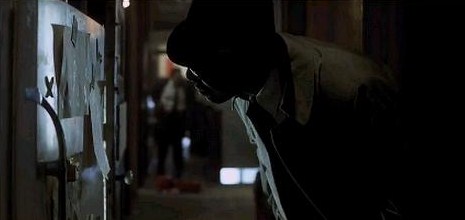
Some directors believe that establishing the tone and mood of the film is essential when opening a thriller as it immediately introduces the audience into the current atmosphere that the characters may be involved in and ergo the current mood states of characters as well as an overall impression of what has occurred or what is going to happen. For an example, in 'Essex Boys' the introduction is immediately solemn with pathetic fallacy references which implies that the character is not optimistic but is already sensing the doom that lays ahead of him.
In this screen shot taken from the opening scene of 'Essex Boys' it immediately grounds the audience to the tone of the film. This is done by simply showing a facial expression of a key character, which exposes a serious and meaningful look to the protagonist, which instantaneously informs the audience of the severity of the situation as well as tension between characters and generally the overall ambience of the film. The low mildly chiaroscuro lighting also reflects the dark and bleak tones of the film, which is again reflected in the setting of an old cobwebbed filled garage, which can be interpreted as a metaphor to mean unfinished business, which is going to be brought to the surface with the help of Billy.
However, if a character appeared cheerfully optimistic usually the director will include subtle signifiers such as bleak weather, limited lighting, or even obscured camera shots that imply to the audience that their glee will abruptly fade and something darker will unveil.
Below is a diagram showing a list of thriller films, and the extent to which each film prioritises and includes genre, character, themes, plot, location, and mood.
The diagram demonstrates how although not one alone aspect seems key when establishing the opening of a thriller, but that Character, themes, and genre seem to be something which many directors choose to focus on establishing in the opening of a thriller.
From looking at what a range of thrillers focus on in the opening sequence, it seems clear that plot is the least common focal point, because I presume often the first few minutes is not enough to establish a complex and versatile plot that so many thrillers contain, or simply that few thrillers themselves rely on the on edge plot to entice the audience in the opening sequence, often opting to rely on the relationship between the characters and the audience and suspense building in the initial sequence.
Although I could rebel and suggest that would be a valid and good reason to deliberately choose to focus on plot because it is deemed least common to establish a plot first, I think that it would make my thriller much too crowded, complex and complicated, possibly meaning that the audience may not understand it, or do not have time to additionally build a relationships with the characters which I think is the key element in an opening of a thriller. In addition, I think that thrillers have a higher impact on the audience when they slowly introduce the characters to the audience and build up tension to unravel the complex or bleak plot. For this reason, I think that for my thriller I will choose to establish the character first as the character is the focus point of our thriller and it is important to put across this to the audience immediately and think it could be composed in a creative enigmatic way to also engage the audience as well as establishing the plot first.
 However, eventually whilst location scouting we found some suitable locations within the city of Norwich which we feel would capture the vintage Noir feel that we aim to create for our thriller. Below is a shot of one of the first locations Elm Hill, which our Femme Fatale character Scarlett will be seen walking swiftly down. This location we feel is suitable and meets the needs required for an old styled thriller, as this is one of the few remaining streets in Norwich that keeps the entirity of it's old fashioned feel intact, with it's cobbled streets, georgian and tudor-style houses, and 1900's style street lights, meaning that in theory the location will not give away the fact that we are filming 70 years after the set time period. Because of the old fashioned street lights, it also means that we can get the ambiant lighting desired to achieve the Film Noir asthetic look meaning that we can film later at night to create a more eerie feel which will add to the essential suspense needed in a thriller.
 In despite of thinking we had then secured our locations to shoot on, we then ventured further down the road and found another small alleyway which we felt would also be perfect for the following scene between Ray and Scarlett.
 The final location we are planning to use, is the City Hall, which is Scarletts desired destination, where she waits alone for her Secret lover, which the audience will not be shown and will therefore be left with the suspense built from the previous scene, as well as the knowledge that her husband is watching her although she is oblibious, which creates a longing to know what she is doing, for the audiences own desire to discover the answers that have been kept hidden from them, which creates an enigma which is again vital in any opening thriller. The obvious advantages to this location are the beautiful time period fitting asthetics which indicate a sense of grandeur in keeping with Scarletts own glamerous appearance, but the building itself is also enigmatic as it is not at all clear to the audience what it is, whether it is a house, or public building or simply an office. Another advantage to this location is the lighting surrounding the building as it is efficent and yet subtle to create good atmospheric mystic lighting.